
Your Next Career Breakthrough May Be in Your Blind Spot
How leaders can use the Johari Window to turn performance reviews into career-development conversations
By Shawn Slusser, Slusser Advisory Group
You are not perfect. But where?
That question can be uncomfortable. Most of us know we have room to improve. What is harder to accept is that other people may see something about us that we cannot yet see ourselves.
I know that is not easy to hear or even talk about.
But we need to embrace it because feedback, especially feedback about our blind spots, can be one of the greatest gifts we receive in our careers.
The Story That Changed How I Viewed Feedback
More than 20 years ago, a leader told me a story that changed the way I thought about feedback. He said:
“For 10 years, people tried to tell me what I needed to work on, and for 10 years, I explained why they were wrong.”
Whenever he received development feedback, he became defensive. He justified his behavior. He explained the circumstances. He told himself that the other person did not fully understand the situation. There was always a reason.
Then one day, he decided to stop explaining and start listening. He accepted the feedback and acted on it. What happened next surprised him. His effectiveness improved. People responded to him differently. New opportunities began to open up. His career started moving forward again.
Then he told me the part I never forgot:
“If I had listened to that feedback 10 years earlier, imagine where my career might be today.”
He believed his pride had cost him a decade of career growth. That hit me hard. I remember thinking that I never wanted to look back and realize I had ignored something that could have made me better.
From that point on, I started treating feedback differently. Instead of only listening for what I agreed with, I began looking for the part I might not be able to see on my own. When I became aware of one, I tried to act on it. That single story shaped my mindset and helped me continue to grow throughout my career.
It also changed the way I led others.
Using the Johari Window in Performance Reviews
As a leader, I came to believe that one of my most important responsibilities was to help my direct reports see what they could not yet see in themselves.
I did not view a performance review as an administrative exercise. I viewed it as an opportunity to act as a career-development coach. The framework I used was the Johari Window.
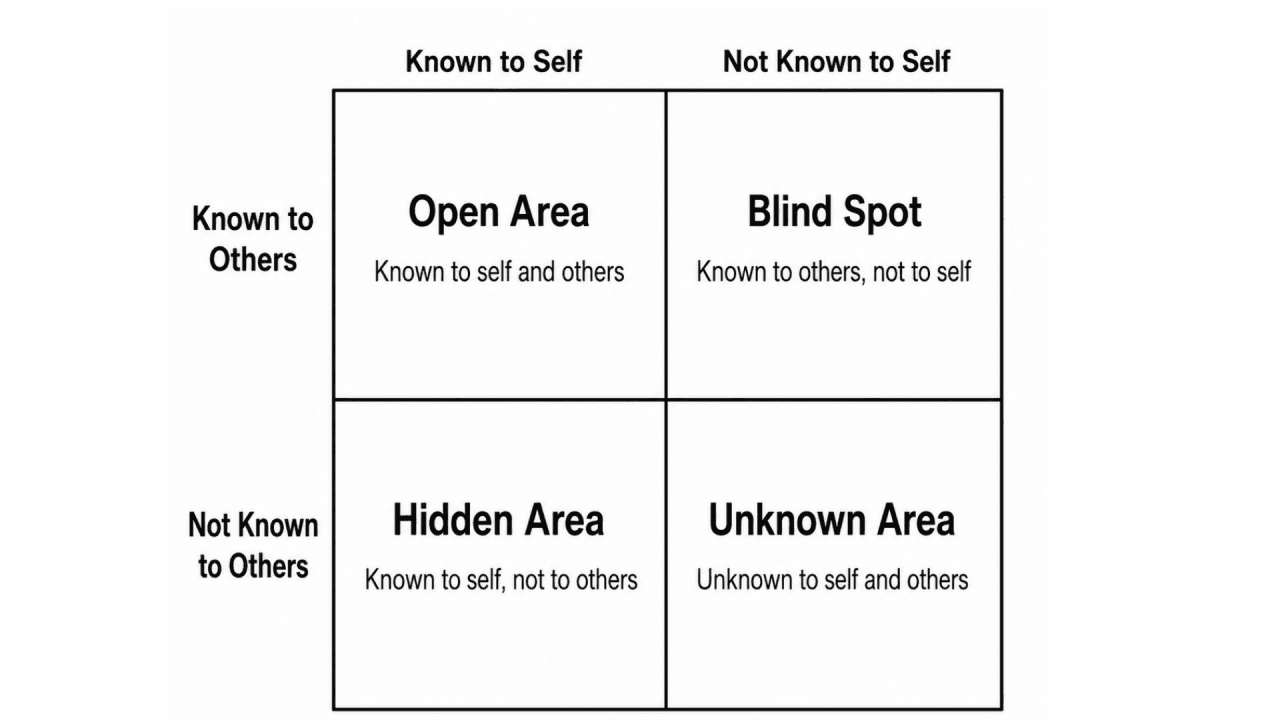
The Johari Window is a simple model of self-awareness with four quadrants:
1. The Open Area
These are the qualities, behaviors, strengths, and limitations that you recognize in yourself and that others also see. This is the part of you that is openly understood and often discussed in performance reviews.
2. The Hidden Area
These are private matters and are typically not discussed in performance reviews.
3. The Unknown Area
Because they have not yet been recognized, they cannot be directly discussed in a performance review.
4. The Blind Spot Area
These are the things other people can see about you that you cannot yet see yourself. They can become barriers to further career development, but they are often considered too uncomfortable or taboo to discuss. This is where I focused much of my development feedback in a performance review.
Preparing Blind Spot Feedback
Before a performance review, I would spend significant time thinking deeply about how the person operated in their role. I would ask myself:
What behaviors may be limiting this person's effectiveness?
What could be preventing them from being considered for a larger role?
What do their colleagues recognize about them that no one has been willing to say directly?
What strength do they have that they may not fully recognize or use?
Once I collected my thoughts and prioritized the most important blind spots for the person, I would then prepare three short blind spot reflection statements. Each statement described something I believed others could see, but the individual might not yet recognize. They were meant to identify the few issues that could have the greatest impact on the person's future development. I would present them as development feedback areas they could reflect on and work to improve.
My message was usually simple:
“These may be standing between you and your next opportunity, broader responsibility, or a future promotion.”
Then I watched how the person reacted.
The Reaction Often Revealed the Mindset
Some people immediately became defensive. They explained why my perception was wrong. They blamed the circumstances. They focused on why others had misunderstood their intentions. They were often more interested in correcting the feedback than learning from it.
Others reacted differently. They said, “Thank you.” They asked questions. They reflected on what they had heard. Most importantly, they acted. Over time, those individuals became stronger. They did not have to agree with every word of the feedback. But they were willing to consider that there might be something important in it.
That openness made a real difference in their development.
Why Many Leaders Avoid These Conversations
Giving meaningful blind-spot feedback is not easy. First, you must pay close attention to the individual and how they interact with others. You need to observe how the person operates, listen to how others experience them, and think seriously about what may be limiting their progress. That takes time and effort.
Second, the conversation can be uncomfortable for both sides, especially the first time. Ask any of my direct reports about their first performance review with me and they will tell you how it surprised them. It is much easier to say: “Great work. Keep doing what you are doing.” That may sound positive, but it’s superficial and rarely helps someone understand what they need to do differently to reach the next level.
Third, not every leader sees themselves as a career-development coach. I did. I believed that helping people grow was part of the responsibility that came with leadership.
Creating More Meaningful Performance Reviews
I practiced this approach for more than 15 years. Over time, I saw how much it could change the quality of the relationship between a leader and a direct report.
We had something meaningful to discuss about their growth and future career opportunities.
At each review, we revisited the blind spots identified previously. If the person still needed to work on them, we stayed with them. If they had made progress, I introduced new areas for development. This created continuity and accountability.
It also reinforced the idea that leadership development is not a one-time event. It is an ongoing process of becoming more self-aware and understanding how others experience you.
Blind Spots Are Not Always Weaknesses
One of the most important lessons I learned is that blind spots are not always negative. Sometimes people are unaware of their greatest strengths.
They may have a natural ability to build trust, simplify complexity, develop talent, influence senior leaders, or create calm during difficult situations. Because the capability comes naturally to them, they may not recognize how valuable it is.
In those situations, the feedback was not about correcting a weakness. It was about helping someone recognize an unconscious strength and encouraging them to use it more deliberately.
That can also accelerate someone’s career trajectory.
So, Ask Yourself:
Do you know your blind spots?
Are you actively searching for them?
When someone gives you difficult feedback, do you listen or immediately explain why they are wrong?
Knowing your blind spots can change your career trajectory.
And If You Are a Leader, Ask Yourself:
Are you acting as a career-development coach and helping your direct reports see what they cannot yet see?
Are you giving them meaningful development feedback, or simply telling them, “Great work. Keep doing what you are doing”?
Identifying someone's blind spots takes time, courage, and care, but it is one of the most valuable gifts you can give them.