I Is for Implementation Know-How: The HAIKU Formula’s Third Element
HAIKU Formula Series — Part 3
By Shawn Slusser, Slusser Advisory Group
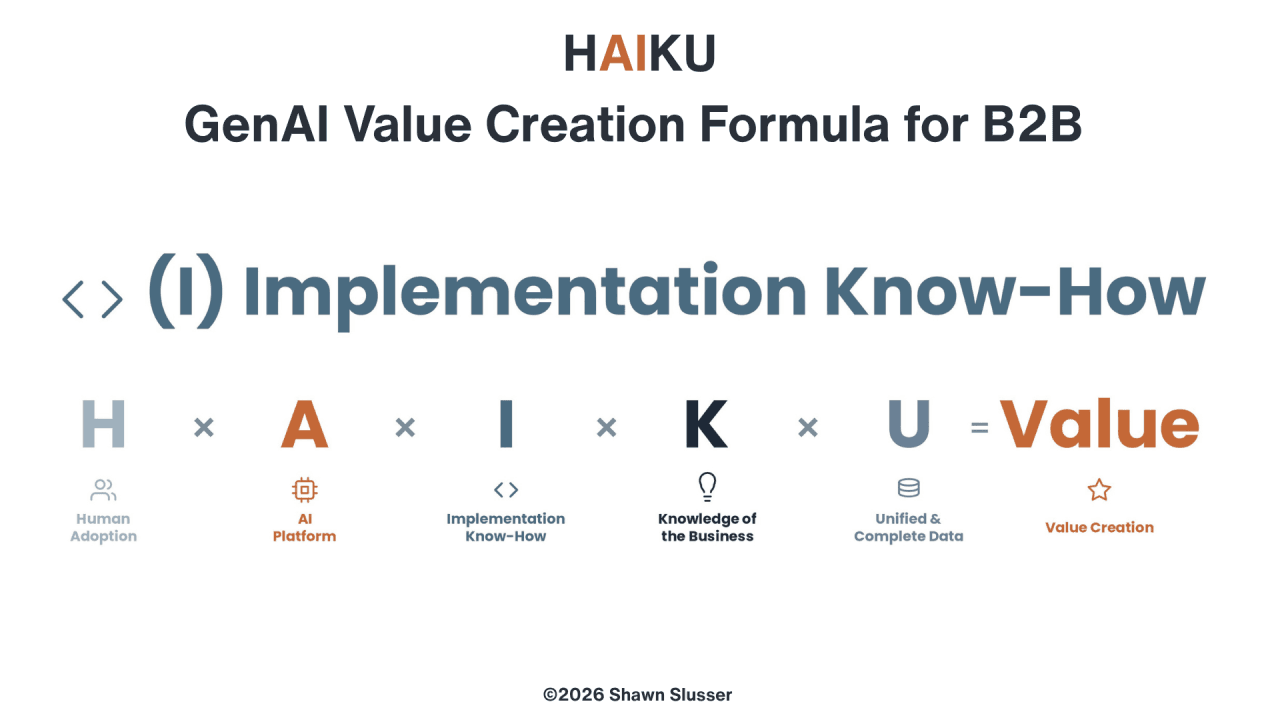
In my HAIKU formula for GenAI value creation, I stands for Implementation Know-How.
In my last post I talked about the AI Platform: the engine that powers GenAI value creation. But an engine sitting in a parking lot doesn’t take you anywhere. Someone has to install it. Someone has to connect it to the systems and workflows that make your business run.
That is the job of your Implementation team. And the skill set they need is rarer than most executives realize.
Three Skills That All Have to Be True at the Same Time
Implementation Know-How is not one capability. It is three distinct areas of expertise that must exist on the same team, at the same time: deep knowledge of your existing technology stack, deep knowledge of your business process workflows, and up-to-date expertise in how to use the latest GenAI platforms effectively.
Most companies have at least one of these covered. Very few have all three.
1. Knowing the Tech Stack
Most large companies have internal IT experts who know the existing tech stack well. They understand the systems, the integrations, the data flows, and the infrastructure. This is the foundation that everything else connects to, and most IT teams can meet this requirement.
Without it, you cannot connect an AI platform to your business at all. It is table stakes. But table stakes alone will not get you to value.
2. Knowing the Business Process Workflows
This is where gaps begin to appear.
Some IT teams have deep knowledge of the business processes they support. They understand how work actually gets done, where the friction is, and what a successful outcome looks like for the people doing the work. When that expertise exists on the implementation team, it dramatically increases the likelihood of building something that creates real value.
Many IT teams do not have this, however. They know the systems, but not the business logic that runs through them. When that perspective is missing, it must be deliberately added to the team. A subject matter expert from the relevant business function, or a dedicated AI Digital Product Owner who can bridge both worlds. Without that bridge, the team builds to a technical specification rather than the business outcome.
3. Knowing How to Use the GenAI Platforms
This is the hardest expertise to maintain, and the one most companies underestimate.
GenAI platforms are evolving at a pace that is genuinely difficult to keep up with. New models, new agent frameworks, new orchestration patterns, sometimes changing week to week. Your team may believe they are current. That belief is often out of date before the project is finished.
I work with AI practitioners in their 20s who are doing things I could not have imagined when I was inside a large company. The speed, the creativity, the command of these tools is genuinely stunning. Every week I see something new that changes what I thought was possible. Executives who assume their internal IT team is operating at that level need to take a closer look. The gap between what the best AI practitioners can do today and what most corporate IT teams know is wider than most leaders realize.
IT teams that are too internally focused, or that assume their existing knowledge covers what they need to know, will miss valuable developments that should be shaping the solution. The result is an implementation built on last year’s understanding of a technology that has already moved on.
The Talent Problem Nobody Wants to Admit
Undoubtedly, there is a real scarcity of skilled GenAI practitioners in the market. Every large company is competing for the same thin pool of people who genuinely understand how to implement and operate these GenAI systems effectively within a business enterprise.
Executives need to do an honest assessment of which GenAI skills exist on their team and which are missing. Not a polite assessment. An honest one. Then build a specific plan to close those gaps, whether through hiring, targeted training, or engaging specialized external partners, often small start-ups, who focus on implementing AI solutions for your industry.
What Happens When You Get This Wrong
When implementation teams lack the workflow knowledge or the GenAI expertise, the result is a technically functional solution that does not create value. The system runs. It produces output but, nobody uses it, or the output doesn’t impact anything that matters to the business or users.
That is a painful and expensive place to end up. Especially when the gaps were visible before the project started.
Three Actions to Take Before Your Next GenAI Initiative
Before your next GenAI initiative gets underway, here are three questions worth answering.
First, confirm you have an IT architect who knows the tech stack for your specific business domain. Not just general IT knowledge. Someone who understands the systems, integrations, and data flows that your use case will need to connect to.
Second, identify who on the project team will own the business process knowledge. This person may not come from IT. If your IT team does not have deep familiarity with the workflows being automated or augmented, assign someone from the business who does. That person must also be empowered to represent the business requirements and make decisions on behalf of the business throughout the initiative. That gap does not fill itself.
Third, do an honest assessment of who the GenAI experts are on your team and what they actually know. Not what their titles say. What they know right now, given how fast the platforms are moving. Bring in a trusted advisor to help you evaluate their current skill set and identify what gaps need to be closed before the work begins. If you need to move fast, consider bringing in an external partner who is already focused on your industry. That gives your internal team speed and time to learn without stalling the initiative.
Follow along as I break down each element of the HAIKU formula in future posts.
Or schedule a call with me if you want to talk through how your GenAI journey maps to the formula.