
6 Steps Bridge Leaders Follow
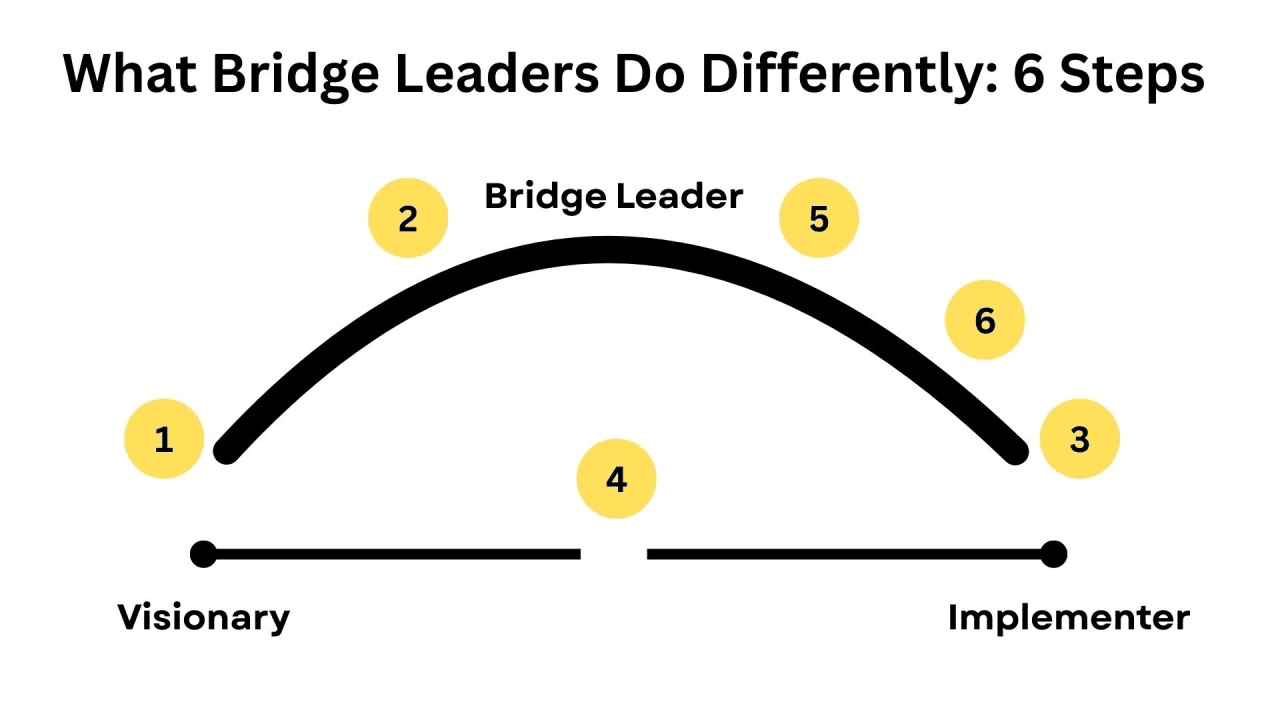
In a previous article, I described three types of leaders that I’ve observed throughout my career: the Visionary, who sees the future before others; the Implementer, who knows how to build and deliver results; and the Bridge Leader, who connects the two.
Through 30+ years of experience working with teams and organizations, I’ve learned that Bridge Leaders must follow a specific set of steps to turn vision into real progress. The six steps that follow are the approach I’ve used to help teams move from ambitious ideas to meaningful results while avoiding the common pitfalls that derail many transformation efforts.
1. Define the Vision for a New Future
A Bridge Leader begins by establishing a clear picture of the desired future state. Sometimes this vision comes from a visionary leader. Other times, there is no true visionary in the organization and the Bridge Leader must define the vision themself.
In my work with teams, I’ve often observed the consequences of skipping this step. Teams launch initiatives to “make things better,” but without a defined future state to align around. This creates confusion, fragmented efforts, and a lack of unity about where the team is actually headed.
A clear vision is the compass. Without it, teams wander.
2. Translate the Vision Into Strategic Tenets
A vision becomes powerful only when it is made actionable. This is where tenets come in.
A tenet is a small set of guiding principles that shape how decisions are made. It is a non-negotiable belief that helps the organization stay aligned with the vision, especially when faced with complex tradeoffs.
Few organizations use tenets well, but one exception I’ve learned from is how Amazon applies this. Amazon teams write tenets for every major program. These tenets act as decision filters by clarifying what the team will always do, what it will never do, and how to stay aligned even when leaders are not in the room.
In my experience, this step is often skipped. Leaders communicate the vision, but do not translate it into principles that guide implementation. Tenets make the abstract concrete.
3. Identify the Problems to Solve
Once the vision and tenets are clear, the Bridge Leader moves to the implementation end of the spectrum. This step is critical and commonly mishandled.
Leaders often try to build the “perfect system” before delivering value. They create massive, long-range implementation plans that take years to complete. The problem is that customers don’t wait. Worse, teams often discover after years of effort that the “perfect system” doesn’t solve the real customer problem.
A better approach is to identify the issues that are blocking value right now. These are the friction points, pain points, and roadblocks that slow down customers or teams. Bridge leaders then work with teams to define near-term deliverables, typically six months or less, that directly address these problems and generate visible progress.
Solve real problems immediately and step by step. Perfection can come later.
4. Connect the Problems Back to the Tenets
This is the moment when the Bridge Leader’s unique capability becomes essential.
Most leaders can list problems. Few can connect those problems back to the vision and tenets. A Bridge Leader evaluates which problems, when solved, will simultaneously deliver customer value and move the organization closer to the future state.
This step often surprises people. Many leaders cannot see the connections between a current pain point and a long-term strategy. The Bridge Leader must guide them, by explaining the links, asking targeted questions, and helping them think across both horizons.
Tenets help identify the right problems to solve and the wrong ones. Solving the wrong problems wastes precious resources and can even take the organization in the wrong direction.
5. Prioritize Ruthlessly
This step may be the most challenging because everyone has an opinion about what matters most.
A Bridge Leader uses structure, not preference, to create alignment. Tenets provide the first filter. Beyond that, I’ve used 2×2 matrices such as effort vs. return to help teams visualize tradeoffs. Another useful filter is hierarchical prioritization, for example, addressing external customer problems before internal stakeholder problems.
The key is to select no more than three to five problems to solve at once. Anything more spreads the team too thin and stalls progress. Momentum comes from focused, incremental progress toward the future state.
6. Engage the Implementers
Now that steps 1–5 have been completed, the implementers can do what they do best, solve targeted, high-impact problems that deliver value and advance the vision. As each problem is solved, the implementation teams can move to the next one on the prioritized list. This creates a sustainable cycle of progress directly linked to the strategic future state.
The Power of a Bridge Leader
Becoming a Bridge Leader takes practice. It requires moving fluidly between two very different leadership modes, vision and implementation, and helping others see connections they cannot yet see. But when performed well, it transforms how an organization works.
Vision becomes actionable. Implementation becomes strategic. And progress becomes real.